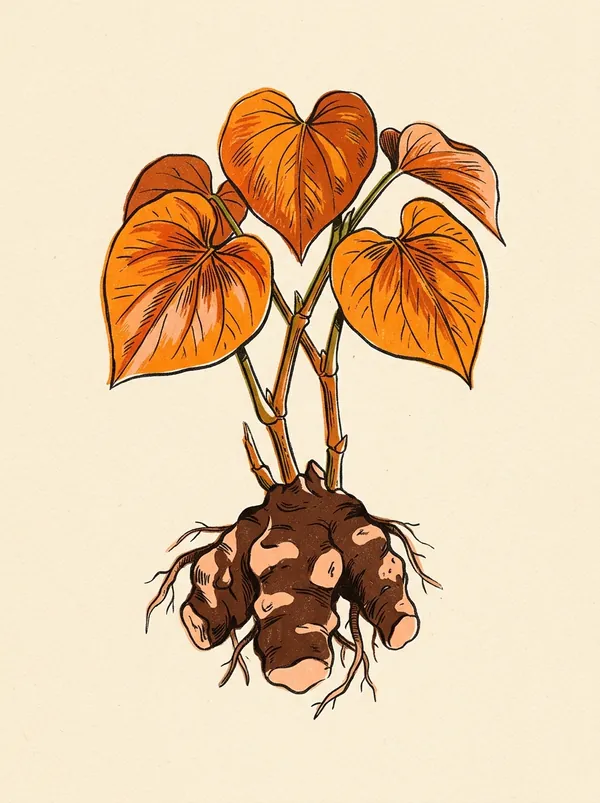
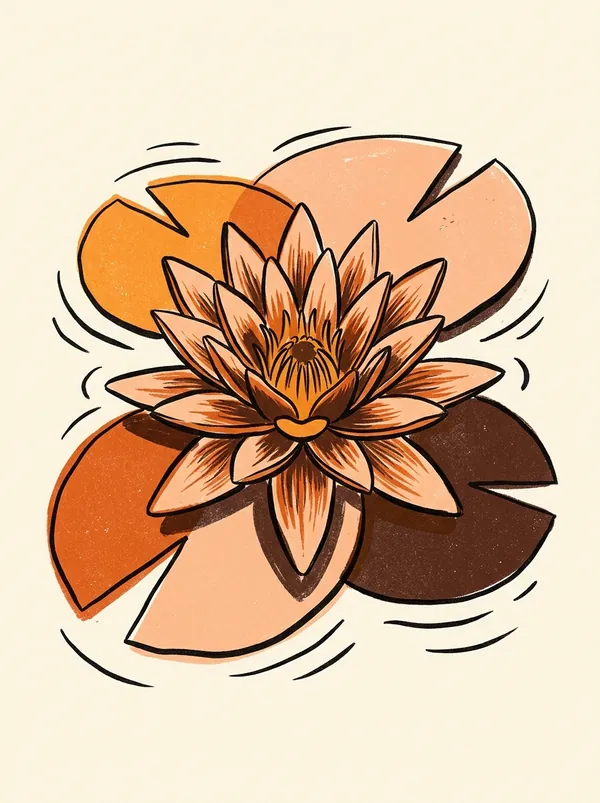
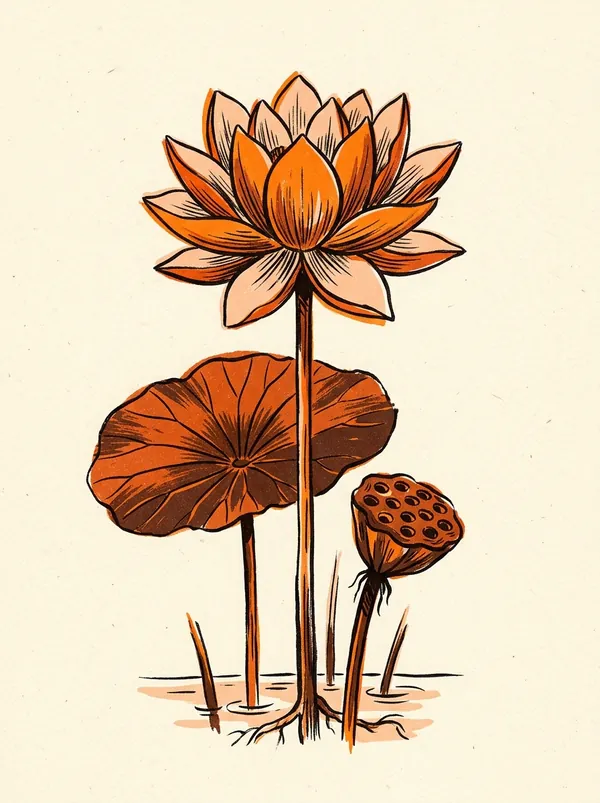
“Blue lotus,” “blue water lily,” “pink lotus,” “white lotus.” I kept seeing these used as if they were one plant in different colors. They aren’t. There is no blue true lotus at all: the true lotus genus has two species, with pink-red, white or yellow flowers. The blue one floating on the Nile is a water lily that borrowed the name.
Side by side
| Feature | Blue lotus | Sacred lotus |
|---|---|---|
| Latin name | Nymphaea caerulea | Nelumbo nucifera |
| Plant family / what it is | Nymphaeaceae (water lily family) | Nelumbonaceae (lotus family); its closest living relatives are plane trees |
| Also called | Blue water lily, Egyptian lotus | Often called “pink lotus” or “white lotus” after its flower color |
| Flower colors | Pale blue | Pink-red or white (the only other true lotus, Nelumbo lutea, is yellow) |
| Where it grows | The Nile and parts of East Africa | Grown widely in Asia as a food plant and an ornamental |
| Part used | Flower | Seeds, rhizome (“lotus root”), leaves and flowers |
| Main compounds researchers study | Nuciferine and apomorphine are often cited, but a 2023 lab study found them virtually absent from authentic extracts | At least 255 constituents reported; nuciferine, an aporphine alkaloid, is studied mainly from the leaves |
| History | Painted and carved throughout ancient Egyptian art; flowers found in Tutankhamun’s tomb | Eaten as a vegetable for over 2,000 years; leaves recorded in the Chinese herbal Ben Cao Gang Mu |
| Legal status in the US | Not federally controlled; on Louisiana’s prohibited-plant list | Not federally controlled; also on Louisiana’s list (garden plants and some labeled supplements are exempt) |
| What to check on the label | Nymphaea caerulea named; flower; extract ratio; batch COA | Nelumbo nucifera named; which part (leaf, seed, flower); batch COA |
Which one fits what you’re after
If you care about
the flower in ancient Egyptian art
Blue lotus
A recurring motif in Egyptian paintings and carvings
If you care about
a plant that is also everyday food
Sacred lotus
Lotus root and seeds are common Asian ingredients
If you care about
the place nuciferine research comes from
Sacred lotus
Most nuciferine studies use Nelumbo leaves; blue lotus results are mixed
What I check on the label
- The Latin name is the whole game: Nymphaea is a water lily, Nelumbo is a true lotus.
- “Blue lotus” should say Nymphaea caerulea. There’s no blue Nelumbo.
- “White lotus” could be a white sacred lotus or a white water lily; only the Latin name tells you.
- Sacred lotus: which part is in the product (leaf, seed, flower) changes what’s in it. Louisiana residents: check state law first.
Is it legal where you live? Rules for kratom and 7-OH change by state and city. Check the state-by-state map on 7-OH Laws
Common questions
Is blue lotus the same as a blue water lily?
Yes. Blue lotus (Nymphaea caerulea) is a water lily; “blue water lily” and “Egyptian lotus” are other names for the same plant.
Is blue lotus a real lotus?
No. True lotuses are the genus Nelumbo, in a different family (Nelumbonaceae). There are two species: Nelumbo nucifera, with pink-red or white flowers, and Nelumbo lutea, with yellow ones.
Is pink lotus or white lotus the same as blue lotus?
Usually not. “Pink lotus” and “white lotus” usually mean the sacred lotus, Nelumbo nucifera. Check the Latin name on the label.
Which one contains nuciferine?
Nuciferine is studied mostly from sacred lotus leaves. It’s often said to be in blue lotus too, but a 2023 GC-MS study found it virtually absent from authentic blue lotus extracts.
Sources (7)
- Dosoky et al. 2023, Chemical composition of blue lotus extracts (Molecules)
- Liu et al. 2023, NnMYB5 and petal color in Nelumbo nucifera (Plant Physiol)
- Wu et al. 2014, Chloroplast genome of Nelumbo nucifera (BMC Plant Biol)
- Chen et al. 2019, Traditional and modern use of Nelumbo nucifera (Crit Rev Food Sci Nutr)
- Ren et al. 2024, Nuciferine from Nelumbo nucifera review (J Ethnopharmacol)
- PubChem: Nuciferine
- Louisiana R.S. 40:989.2, prohibited plant products
— Dan
Updated by Dan Mercer.