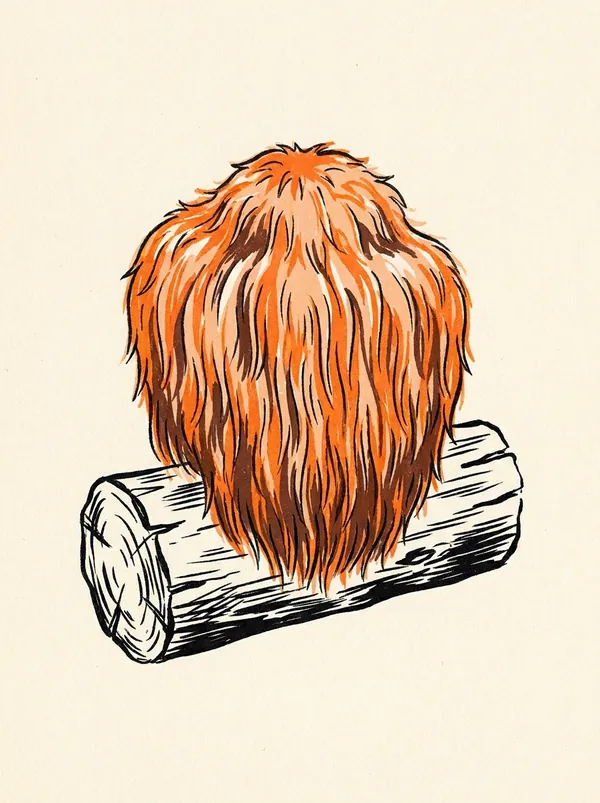
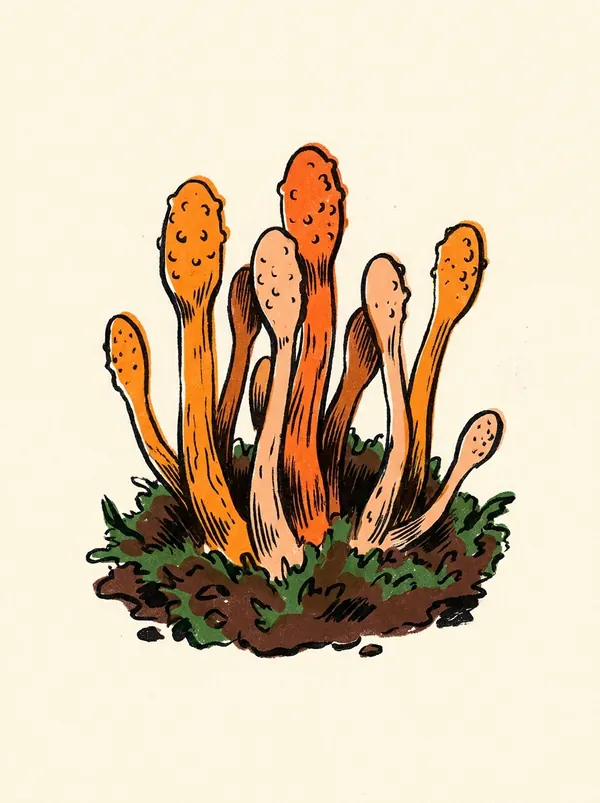
Both get sold as “functional mushrooms,” often in the same blend, but they barely resemble each other. Lion’s mane is something you could cook. Wild cordyceps is a fungus that grows out of a buried caterpillar, and it’s so rare and expensive that most of what’s sold is cultivated on grain or in liquid culture. Which cordyceps a label means is the first thing I check.
Side by side
| Feature | Lion’s mane | Cordyceps |
|---|---|---|
| Latin name | Hericium erinaceus | Cordyceps militaris, or Ophiocordyceps sinensis (renamed from Cordyceps sinensis in 2007) |
| Family / what it is | Hericiaceae; a white, shaggy mushroom with hanging spines | Cordycipitaceae / Ophiocordycipitaceae; fungi that grow on insects |
| Where it grows | On dead or dying hardwood trees | Wild O. sinensis: on moth larvae, high on the Qinghai-Tibetan Plateau; C. militaris is widely cultivated |
| What’s usually sold | Fruiting body and mycelium | Cultivated C. militaris, or fermented strains such as Cs-4 (Paecilomyces hepiali); wild O. sinensis is rare and costly |
| Main compounds researchers study | Hericenones (from the fruiting body) and erinacines (from the mycelium), plus polysaccharides | Nucleosides, mainly cordycepin (3′-deoxyadenosine) and adenosine, plus polysaccharides |
| Common forms sold | Capsules, powders, liquid extracts, coffee blends, gummies | Capsules, powders and extracts; whole dried cordyceps, wild or cultivated |
| How it’s usually taken | Eaten as a culinary mushroom in East Asian cooking | Wild cordyceps has been used in traditional Chinese medicine since at least the 1400s |
| Legal status in the US | Sold as a food and dietary supplement; not controlled | Sold as a dietary supplement; not controlled |
| Safety notes worth reading | MSK: generally considered safe as food; supplements are more concentrated | MSK: may interact with blood thinners and diabetes drugs; one case report of excessive bleeding |
| What to check on the label | Fruiting body or mycelium, beta-glucan %, species named | Species or strain (C. militaris, O. sinensis, Cs-4), fruiting body or mycelium, cordycepin or adenosine %, batch COA |
Which one fits what you’re after
If you care about
a mushroom that is also food
Lion’s mane
Eaten fresh, dried or cooked in East Asian cuisine
If you care about
a fungus with a strange life story
Cordyceps
Wild O. sinensis grows from moth larvae; its Chinese name means “winter worm, summer grass”
If you care about
labels that tell you what’s inside
Either
Species or strain named, plus fruiting body vs mycelium
What I check on the label
- Cordyceps: which one? C. militaris, O. sinensis and Cs-4 are different organisms; the label should say.
- Fruiting body or mycelium, and if mycelium, what it was grown on (brown rice is common).
- Wild O. sinensis at a low price is a red flag; a 2025 review documents substitution and mislabeling.
- Cordyceps: MSK suggests talking to a doctor first if you take blood thinners or diabetes medicine.
Is it legal where you live? Rules for kratom and 7-OH change by state and city. Check the state-by-state map on 7-OH Laws
Common questions
Is cordyceps a caterpillar?
Wild Ophiocordyceps sinensis is a fungus that grows on moth larvae, so the dried product is fungus and larva together. Cultivated Cordyceps militaris and fermented strains like Cs-4 are usually grown on grain or in liquid culture.
What is cordycepin?
A nucleoside closely related to adenosine (it’s 3′-deoxyadenosine), isolated from Cordyceps militaris. A 2026 review lists cordycepin and adenosine among C. militaris’s main nucleosides.
Do lion’s mane and cordyceps have the same effects?
This notebook doesn’t compare effects. Here’s what the research has looked at: lion’s mane for hericenones and erinacines, cordyceps mainly for cordycepin, adenosine and polysaccharides.
Are lion’s mane and cordyceps legal?
Yes. Both are sold as dietary supplements in the US and neither is a controlled substance.
Sources (9)
- Memorial Sloan Kettering, About Herbs: Lion’s mane
- Friedman 2015, Chemistry of Hericium erinaceus (J Agric Food Chem)
- Memorial Sloan Kettering, About Herbs: Cordyceps
- Yang & Jin 2026, Cordyceps militaris and its constituents: a review (Phytother Res)
- Zhou et al. 2014, Artificial cultivation of Ophiocordyceps sinensis in China (Crit Rev Biotechnol)
- Meng et al. 2025, Chinese cordyceps products and authenticity assessment (Crit Rev Biotechnol)
- Krishna et al. 2025, Cultivation strategies for C. sinensis and C. militaris (Mol Biotechnol)
- Yao et al. 2026, Paecilomyces hepiali Chen (Cs-4) polysaccharides (J Ethnopharmacol)
- PubChem: Cordycepin
— Dan
Updated by Dan Mercer.