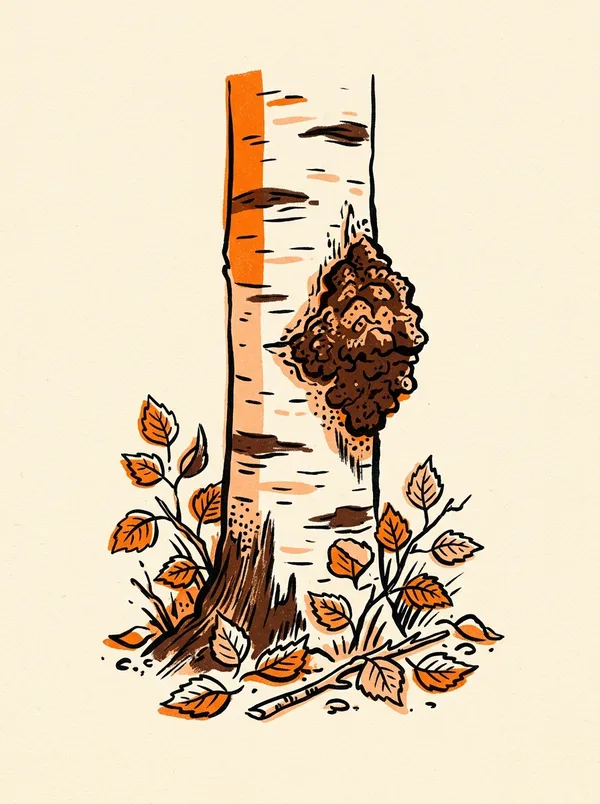
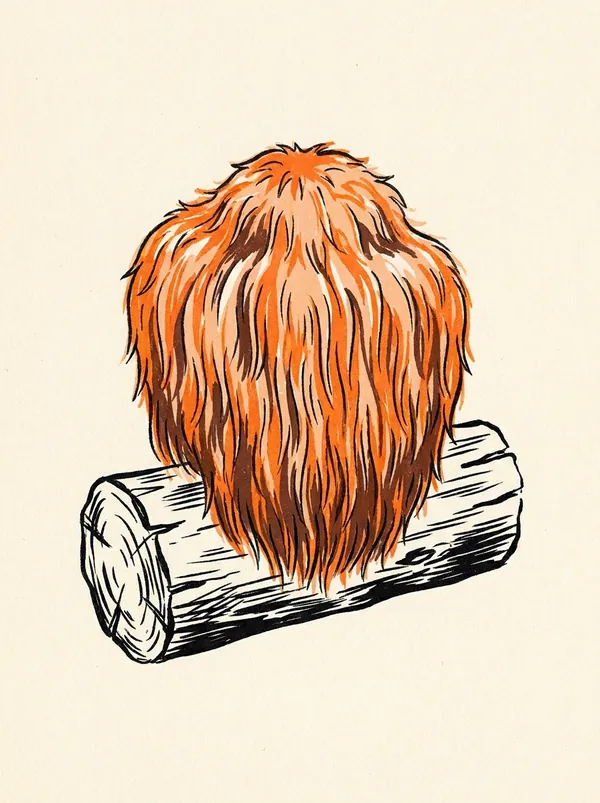
Chaga is the one that surprised me most in the mushroom aisle, because it isn’t a mushroom cap at all. It’s a charcoal-black lump on a birch trunk, made of fungal tissue, and most of what’s sold is still wild-harvested. Lion’s mane is a cookable mushroom you’d recognize at a market. On the chaga side, the row I’d read first is the safety one.
Side by side
| Feature | Chaga | Lion’s mane |
|---|---|---|
| Latin name | Inonotus obliquus | Hericium erinaceus |
| Family / what it is | Hymenochaetaceae; a white-rot fungus that forms a black, irregular sterile conk on trees | Hericiaceae; a white, shaggy mushroom with hanging spines |
| Where it grows | Mainly on birch in cold climates; grows slowly | On dead or dying hardwood trees |
| What’s usually sold | The conk, mostly wild-harvested from birch; in nature it rarely forms a true fruiting body | Fruiting body and mycelium |
| Main compounds researchers study | Melanins, lanostane-type triterpenoids such as inotodiol, phenolics and polysaccharides; betulinic acid comes from the birch host | Hericenones (from the fruiting body) and erinacines (from the mycelium), plus polysaccharides |
| Common forms sold | Chunks and ground conk for tea, powders, capsules, extracts | Capsules, powders, liquid extracts, coffee blends, gummies |
| How it’s usually taken | A folk remedy in Russia and Northern Europe since at least the 1500s | Eaten as a culinary mushroom in East Asian cooking |
| Legal status in the US | Sold as a dietary supplement; not controlled | Sold as a food and dietary supplement; not controlled |
| Safety notes worth reading | MSK: oxalate kidney-injury case reports after long-term powder use (one powder tested at 14.2 g oxalate per 100 g); may raise bleeding risk with blood thinners | MSK: generally considered safe as food; supplements are more concentrated |
| What to check on the label | Inonotus obliquus named; wild conk or lab-grown mycelium; what the mycelium was grown on; batch COA | Fruiting body or mycelium, beta-glucan %, species named |
Which one fits what you’re after
If you care about
a mushroom that is also food
Lion’s mane
Eaten fresh, dried or cooked in East Asian cuisine
If you care about
a northern folk tradition
Chaga
Used in Russia and Northern Europe since at least the 16th century
If you care about
labels that tell you what’s inside
Either
Species named, plus conk, fruiting body or mycelium
What I check on the label
- Chaga: Inonotus obliquus on the panel, and whether it’s wild conk or lab-grown mycelium.
- Mycelium products: what was it grown on? Mycelium grown on grain can carry a lot of starch.
- Chaga: MSK lists oxalate kidney-injury cases. Ask a doctor first if you have kidney problems.
- Chaga: MSK also suggests caution with blood thinners and diabetes medicine.
Is it legal where you live? Rules for kratom and 7-OH change by state and city. Check the state-by-state map on 7-OH Laws
Common questions
Is chaga a mushroom?
It’s a fungus, but what’s sold isn’t a typical mushroom. In nature Inonotus obliquus rarely forms a fruiting body; the product is usually its black, sterile conk, a mass of fungal tissue that grows on birch.
Is chaga the same as lion’s mane?
No. Chaga (Inonotus obliquus) and lion’s mane (Hericium erinaceus) are different fungi in different families, with different compounds.
Why is chaga linked to kidney problems?
It can be very high in oxalate. Case reports describe oxalate kidney injury after long-term chaga powder use, and one leftover powder measured 14.2 g of oxalate per 100 g. Ask a doctor first if you have kidney problems.
Do chaga and lion’s mane have the same effects?
This notebook doesn’t compare effects. Here’s what research has looked at: chaga for melanins, triterpenoids and polysaccharides, mostly in lab and animal studies; lion’s mane for hericenones and erinacines.
Sources (7)
- Memorial Sloan Kettering, About Herbs: Chaga mushroom
- Zheng et al. 2010, Metabolites in the sclerotia of Inonotus obliquus (Appl Microbiol Biotechnol)
- Ern et al. 2023, Inonotus obliquus (chaga) review (Mycology)
- Lee et al. 2020, Kidney failure after long-term chaga ingestion: case report (J Korean Med Sci)
- Kwon et al. 2022, Chaga-induced oxalate nephropathy: case report (Medicine)
- Memorial Sloan Kettering, About Herbs: Lion’s mane
- Friedman 2015, Chemistry of Hericium erinaceus (J Agric Food Chem)
— Dan
Updated by Dan Mercer.