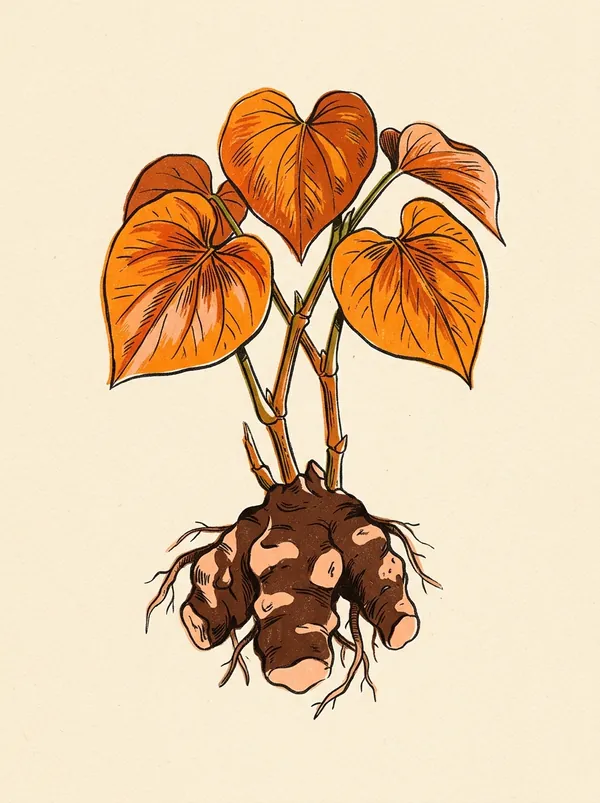
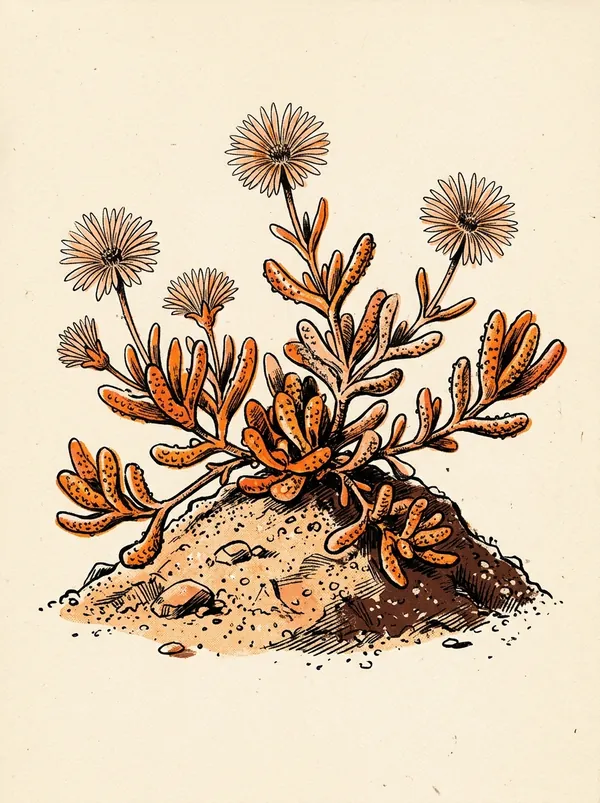
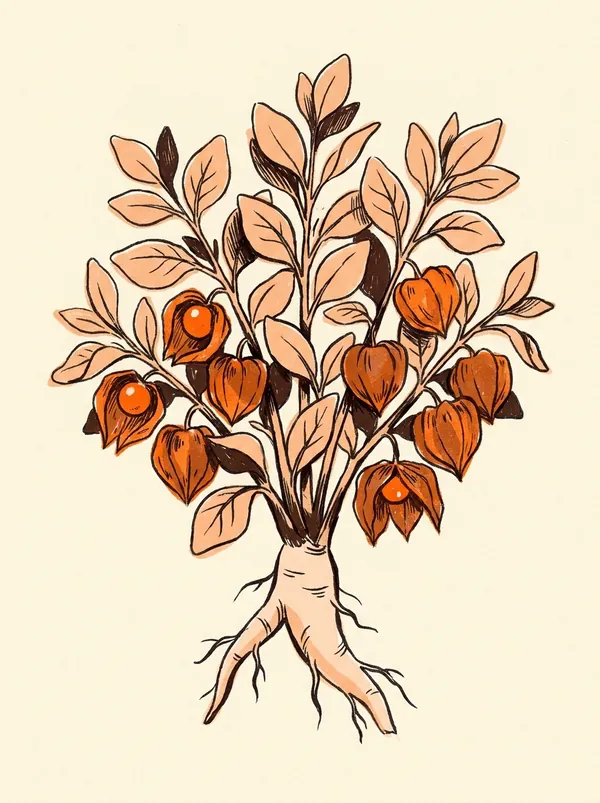
These two keep landing in the same blends and the same search results, so people assume they belong to one category. One is a ground-hugging succulent from the Karoo; the other is a shrub root from Ayurvedic tradition, a cousin of tomatoes. The rows I read twice were the safety notes, because each plant has its own.
Side by side
| Feature | Kanna | Ashwagandha |
|---|---|---|
| Latin name | Sceletium tortuosum | Withania somnifera |
| Plant family / what it is | Aizoaceae (ice plant family); a low succulent | Solanaceae (nightshade family); an evergreen shrub |
| Where it grows | South Africa, mainly the dry Karoo region | Parts of India, Africa and the Middle East |
| Part used | Above-ground parts, traditionally fermented and dried | Root, leaf, or a root-and-leaf extract |
| Main compounds researchers study | Mesembrine-type alkaloids: mesembrine, mesembrenone, mesembrenol | Withanolides (steroidal lactones such as withaferin A), plus alkaloids and saponins |
| Common forms sold | Fermented dried plant, extracts, capsules, tablets, gummies | Root powder, capsules, extracts, gummies |
| How it’s usually taken | Traditionally chewed by San and Khoikhoi peoples; today mostly sold as extracts | Used in Ayurveda, India’s traditional medicine, for thousands of years |
| Legal status in the US | Not federally controlled; Louisiana restricts it | Sold as a dietary supplement; not a controlled substance |
| Outside the US | Rules vary by country | Denmark’s food authority has banned it, citing a 2020 risk assessment; the decision has been disputed |
| Safety notes worth reading | Not with antidepressants or other serotonergic drugs; ask a doctor first | NCCIH: rare liver-injury cases; avoid in pregnancy; not recommended with thyroid or autoimmune disorders |
| What to check on the label | Extract ratio or alkaloid %, fermented or not, batch COA | Root only or root + leaf, withanolide %, extract type, batch COA |
Which one fits what you’re after
If you care about
a documented history in Southern Africa
Kanna
San and Khoikhoi use was written down by European travelers in the 1600s
If you care about
a plant from Ayurvedic tradition
Ashwagandha
Recorded in Ayurveda for thousands of years
If you care about
a percentage on the label you can compare
Both
Alkaloid % for kanna; withanolide % for ashwagandha
What I check on the label
- Kanna: an extract ratio (like 10:1) or a standardized alkaloid %, and whether the plant was fermented.
- Ashwagandha: root only, or root and leaf? NCCIH notes products use either, so the label should say.
- Ashwagandha: a withanolide % and the extract type, not just “ashwagandha extract.”
- Blends: each ingredient’s amount listed. Taking medication? Ask a doctor first; both have notes.
Is it legal where you live? Rules for kratom and 7-OH change by state and city. Check the state-by-state map on 7-OH Laws
Common questions
Is kanna the same as ashwagandha?
No. Kanna is a South African succulent (Sceletium tortuosum); ashwagandha is a nightshade-family shrub (Withania somnifera). Their compounds are unrelated.
Do kanna and ashwagandha have the same effects?
This notebook doesn’t compare effects. Here’s what each is: kanna is studied for mesembrine-type alkaloids, ashwagandha for withanolides, a group of steroidal lactones. Different plants, different chemistry.
What are withanolides?
Steroidal lactones that define ashwagandha’s chemistry; withaferin A is the best known. They occur mainly in the nightshade family, including ground cherries (Physalis).
Are kanna and ashwagandha legal?
In the US, yes, with one exception: Louisiana restricts kanna. Ashwagandha is sold as a dietary supplement; Denmark has banned it.
Sources (8)
- Olatunji et al. 2022, Sceletium tortuosum review (J Ethnopharmacol)
- Gericke & Viljoen 2008, Sceletium: a review update (J Ethnopharmacol)
- 7-OH Laws: kanna by state
- NCCIH: Ashwagandha
- Memorial Sloan Kettering, About Herbs: Ashwagandha
- Narayanan & Nagegowda 2024, Biosynthesis of withanolides in Withania somnifera (Curr Opin Plant Biol)
- Huang et al. 2020, Withanolides from the genus Physalis (J Pharm Pharmacol)
- Patwardhan et al. 2024, Danish ban on ashwagandha (J Ayurveda Integr Med)
— Dan
Updated by Dan Mercer.